Contact Me

Rhythmic Subjects (2021)

How can the heartbeat become a measure of time passing?
How does the body become a form of communication in the absence of language?
Rhythmic Subjects is a performative piece that explores internal bodily rhythms through the tapping of one’s own heartbeat. The sound of a heartbeat can be so faint that we often ignore its presence as each day passes. Yet when we do notice it, the sound can feel deafening. Through the translation of internal bodily sounds, the heartbeat is reimagined as a communicative agent—one that reflects a heightened physical awareness of presence.
By activating bodily senses and extending durational time, the performance evokes an unsettling awareness of our relationship with the human body—a creative reimagining of the metronome, replaced here by the organic rhythm of life itself. In doing so, a new form of dialogue and communication is made possible. This piece focuses on the articulation of experience and draws on themes of intimacy, repetition, continuation, and time.
> Inspiration & Research
Performers are asked to lie down in a horizontal position onto a bed, with their head on the surface of their palm. Through the regulation of their own emotional and mental states, they proceed to listen to their heartbeat and tap out the rhythmic sound using their index fingers. The objective of this creative act is an attempt to achieve synchronization with the individuals’ bodily sensations, thus, making internal sounds visible to an audience.


The inspiration for this piece comes from my bed, a safe space that allows me to regulate my emotional and mental state. Through this repetitive process of listening and tapping the rhythm of my heartbeat, it became both a source of comfort and a reminder of being alive.
This performative piece is deeply personal and takes place in my bedroom: an attempt to preserve the purity and intimacy of the original experience. By inviting performers to encounter the same space, I extend my personal, private environment to others in order to recreate that sense of presence. Can one become attuned to both their own heartbeat and the heartbeats of others—coexisting with their presence as an unnoticed yet constant rhythm of life? How does sound articulate into an experience? Does the repetition of sound generate a sense of continuation? Here, the simple act of tapping becomes a creative catalyst, producing sound as a means of communication in the absence of language.
Photo-Etching Prints

To retain the essence of the performance as a live event, I used the method of photo-etching to preserve and capture moments of the experience. This printmaking process involves repeatedly transferring a photograph onto a metal plate using acid and chemicals, resulting in a series of photo-etched prints. Through this method, I am able to revisit the experience even after it has become an ‘object’ for display. Engraving the performance onto a metal surface introduces a physical, tactile dimension to the work, inviting viewers to engage with it through a tangible, material experience.
A total of 9 photo-etching prints were made from the etching plate. Each print requires precision and careful alignment to produce a ‘real photo-like’ image of the original photograph. The grainy texture further retains the ‘essence’ of the performance and restores ‘life’ back into the image.

Morse Hearts (2021)
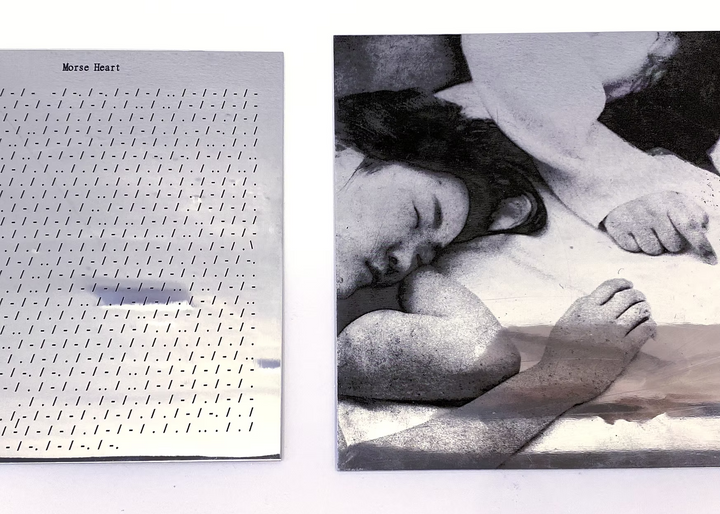
As a continuation of 'Rhythmic Subjects', I asked the question: How can the audience encounter a bodily experience through translation?
In Morse Heart, I aim to heighten the presence of the heartbeat by translating its rhythmic patterns into Morse code. Morse code, commonly known as a method of communication using dots and dashes to represent letters and words, becomes a tool for reinterpreting the body. Here, the heartbeat is personified, voicing phrases like “I’m here” and “I’m alive.”
The morse code is played through a speaker, reverberating throughout the surrounding environment. Although the heart resides within the body, I aim to externalise its deafening presence, allowing the audience to physically connect with this internal organ. This creates a unique form of dialogue—one that allows the audience not only to hear but also to feel the heartbeat’s transcendent presence.
The morse code is transferred onto a metal plate through UV printing. I find it interesting how the code resembles punctuations in language; especially, eclipses and full stops. The visual representation of this rhythmic pattern indicates the slowness of time as well as the notion of repetition and continuation.


